In this guide
A photo makes a good oil painting when the face is sharp, the light is even and the camera was at eye level. Send the original file rather than a screenshot, and resolution rarely becomes a problem. Focus, light and angle matter far more than megapixels, because the artist paints what they can see.
What makes a good photo for an oil painting?
Our artists work from the photo you send, so the photo sets the ceiling on the painting. Before you send one, check it against this list.
- The eyes are in focus. Zoom in on the face on your phone. If the eyes and eyelashes stay crisp, the photo is sharp enough.
- The light is even. Open shade outdoors, or a room lit by a window, shows the shape of a face. Direct midday sun and on-camera flash flatten it.
- The camera is at eye level. A photo taken from below broadens the jaw and nose. One from above shrinks the chin. Eye level looks like the person you know.
- The face fills a decent part of the frame. A head in the far distance leaves the artist guessing at features.
- It is the original file. Send the photo from your camera roll, not a screenshot of it and not a version downloaded from social media.
Send two or three options if you are torn. We will tell you which one will paint best before any work starts.

Does the photo need to be high resolution?
Less than most people expect. A photo taken on any phone from the last few years, sent at full size, carries enough detail for every portrait size we offer, up to 100 x 150 cm. What causes trouble is not the camera but what happens to the file afterwards.
A photo saved from Facebook, Instagram or a group chat has been compressed, sometimes to a fraction of its original size. A screenshot is a photo of a screen. Both arrive soft, and soft detail cannot be invented. If you have the original, always send that.
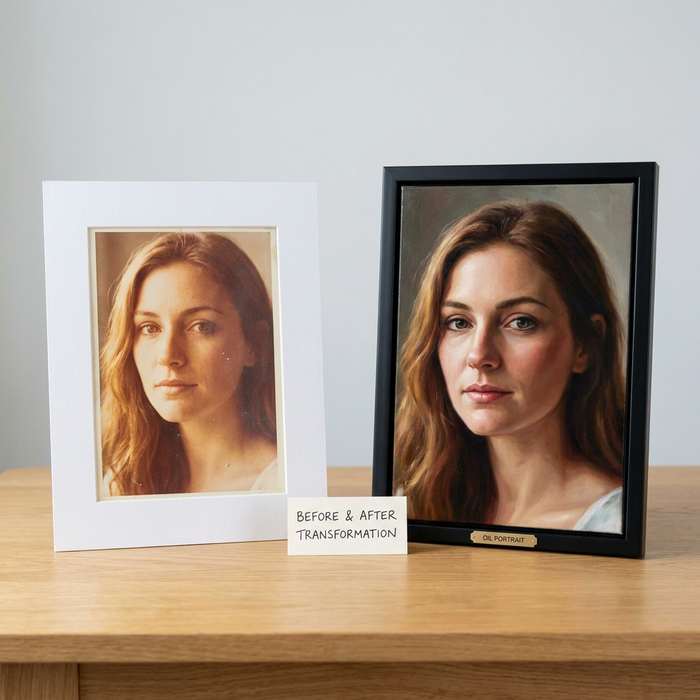
For an old print, photograph it flat in daylight with no flash, or scan it at 600 dpi. Faded, creased and torn photos are still workable: our artists rebuild what the print has lost, and you see the result before you pay the balance.
Which photos cause the most trouble?
These are the problems we see most often, and what to send instead.
| The photo | Why it makes painting harder | Send instead |
|---|---|---|
| On-camera flash at night | Flat light, hard shadow behind, red or glassy eyes | Anything taken in daylight or by a window |
| Strong backlight or sunset behind the subject | The face falls into shadow and loses detail | The same pose with the light behind you, the photographer |
| Taken from below, or a selfie at arm's length | Distorts the nose, jaw and forehead | Eye level, camera a couple of metres back, slightly zoomed |
| Sunglasses, a cap or a low hat brim | The eyes carry the likeness, and they are hidden | Nothing shading the eyes |
| Screenshot, or downloaded from social media | Compressed, so skin, hair and eyes turn mushy | The original file from the camera roll |
| A beauty or smoothing filter | Removes the features that make the face recognisable | The unfiltered version |
| A pet mid-run, or looking away | Motion blur, and the eyes are not readable | A still moment at the pet's eye level, ideally outdoors |
None of these rule a photo out. They simply mean the artist has less to work from, so ask us first rather than wondering.
Can you combine photos, or paint someone who is no longer here?
Yes to both. A portrait can be built from more than one photo, so a family that was never in the same frame can share one canvas, up to four subjects. We can also change or simplify the background, remove clutter, and set people somewhere that matters more than where the photo was taken.
Memorial portraits of people and pets are painted the same way, from whatever photo you treasure, even an old one. For a pet, start on our custom pet portraits page, which covers dogs, cats and horses.

Which painting style suits your photo?
Every custom portrait is 100% hand-painted in oils on canvas by a professional, university-trained artist. You choose the style when you order.
- Realism follows the photo closely. It suits a formal portrait, a wedding photo and most memorial portraits.
- Impressionist keeps the likeness but leaves the brushwork visible, with looser edges and warmer colour. It forgives a slightly soft photo.
- Pop art reworks the photo in bold, flat colour. It suits a single strong face or a pet with character, and it reads well from across a room.
Hand-painted work is never a pixel copy of a photograph, and screen colours vary between devices, so treat the photo as the reference rather than the target. You can see how oil on canvas actually behaves up close on our close-up examples page.
What size should a portrait from a photo be?
Portraits come in five sizes. Match the size to how many subjects are in the painting and how close in you want the faces.
| Size (W x H cm) | Suits | Where it works |
|---|---|---|
| 40 x 50 | One face, close in | A shelf, a desk, a narrow wall |
| 50 x 70 | One person, head and shoulders | A hallway or beside a bed |
| 60 x 90 | One or two subjects | A bedroom wall or a dining nook |
| 90 x 120 | Two to four subjects, or one full length | Above a sideboard or a sofa |
| 100 x 150 | A family group, full length | A living room feature wall or a stairwell |
Extra subjects need room to breathe, so a family of four reads far better at 90 x 120 than at 50 x 70. For general hanging heights and wall widths, see our size guide.
How is a hand-painted portrait different from an AI filter or a canvas print?
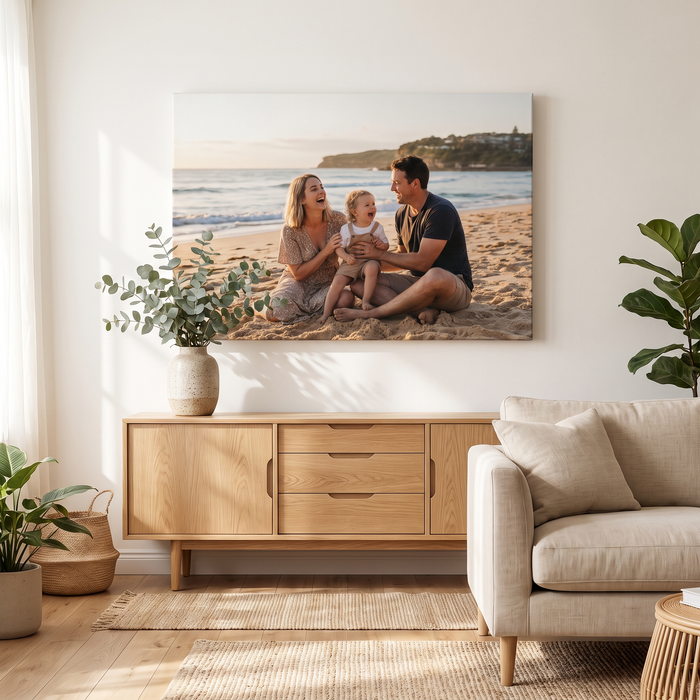
Search for a painting from a photo and you will find three different things. A filter or an app that adds an oil-painting effect only rearranges the pixels of your photo: on screen it can look convincing, and printed large it looks like a photo with texture drawn over it. A canvas print reproduces your photo exactly as it is, which is the right answer when you love the photo itself.
An oil painting is brushed by hand over days. Paint sits above the canvas, edges are decided by a person, and the artist can fix the things a camera got wrong. If what you want is the photo on canvas rather than a painting, use Print Your Own Image on Canvas instead, which is clearly sold as a print.
How the process runs
- Send your photo with your order, or email it to us afterwards.
- Pay a 20% deposit. That is all that is charged to start.
- Your artist paints in oils on canvas. Portraits take 21 to 28 days.
- We send you a photo of the finished painting for approval.
- Ask for changes. Adjustments are unlimited and free.
- The balance is charged only once you have approved it, then the painting is delivered free anywhere in Australia.
Every order, portraits included, carries our 30-day money-back guarantee.
Questions people ask
Can I send the photo after I have ordered?
Yes. Order first and email the photo to us, or call 1300 90 21 53 if you would rather talk it through before you buy. Nothing is painted until the photo is agreed.
Can you use a photo taken by a professional photographer?
Ask the photographer's permission first, since they usually hold the copyright in their images. Family snapshots you took yourself are never a problem.
Can you change what is in the photo?
Within reason, yes. Backgrounds can be replaced or simplified, clutter and stray people can go, and subjects from separate photos can be brought together. Inventing a face that appears in no photo is not something we can do well, so we will say so.
What if the finished painting does not look right to me?
Say so at the approval stage and the artist keeps working, at no extra cost, until you are happy. You pay the balance only after you approve it, and the 30-day guarantee still applies once it arrives.
Related guides
- Christmas gift ideas for her: personal gifts she'll treasure
- When to order art for Christmas in Australia
- Art above the bed: what size and how high
Next step: Start a custom portrait from your photo, or send the photo to us first and we will tell you how it will paint.