In this guide
What is a floating frame for canvas prints and paintings?
A floating frame is a slim timber frame that sits around a stretched canvas with a small gap between the canvas edge and the frame, so the painting appears to float inside it. Direct Art offers floating frames in gold, black, silver, natural and white on every canvas print and on most paintings, and they add about 2 to 3 cm to each side of the canvas size you choose.
That is the short answer. The longer one covers how the shadow gap works, which colour suits which painting, what a floating frame does to the finished size, when a plain stretched canvas looks better, and when an ornate gold frame beats both.
The painting or print is first stretched over a timber frame, the same gallery wrap as our stretched paintings. The floating frame is then fitted around it with a 5 to 10 mm channel left open all the way round. There is no glass, no mat board and nothing touching the painted surface. The canvas edges stay visible inside the gap, which is why a floating canvas frame reads as lighter and more modern than a traditional frame, while still giving the work a clean finished edge. Every painting and print is stretched and framed in Melbourne before it is delivered, and it arrives ready to hang.

Which floating frame colour suits which painting?
Pick the frame to match the room first and the painting second. The frame is the point where the artwork meets the wall, so a colour that already appears in the room (the timber of a sideboard, a black window frame, a brass lamp) ties the painting in. Then check it against the dominant colour in the painting itself. The table gives the pairings that work most often.
| Floating frame | Suits these paintings | Suits these rooms |
|---|---|---|
| Black Floating Frame | Bold abstracts, black and white prints, deep blues and greens, anything with strong contrast | Modern, industrial, white walls, black window frames and tapware |
| White Floating Frame | Coastal scenes, pale abstracts, soft pastels, botanical prints | Coastal, Scandinavian, light-filled rooms, bedrooms |
| Natural Floating Frame | Landscapes, warm earthy palettes, impressionist work, pop art with a light ground | Oak and ash furniture, Japandi, family living rooms |
| Gold Floating Frame | Klimt, Van Gogh and other famous works, portraits, rich reds and ochres | Traditional or glamorous rooms, dining rooms, anywhere with brass |
| Silver Floating Frame | Cool greys and blues, cityscapes, photographic prints | Offices, apartments with chrome and glass |
One rule covers most cases: if the painting has a lot of white or cream in it, a white frame disappears and a black or natural one gives it an edge. If the painting is dark, a white frame can look like a border rather than a frame, and natural or gold is kinder. Screen colours vary, and a hand-painted work will differ slightly from its photo, so judge the pairing against the painting's overall tone rather than one exact shade.
The frame colour swatches appear on every product page once you pick a finish. For a painting that shows all five, see Kaleidoscope Stag, a pop art deer where the white or natural options sit best against its pale grey ground.

Floating frame or stretched canvas: which looks better?
Both are finished pieces, and neither is wrong. The difference is in the edge.
A stretched canvas, which we list as "Stretched Ready to Hang" on paintings and prints, is the painting wrapped around a timber stretcher with the image or a painted colour continuing over the sides. It has no border at all, so it suits paintings whose background runs off the edge, gallery walls where several pieces hang close together, and rooms where you want the artwork itself to be the only line on the wall. It is also the finish our artists paint for, so the sides are part of the work.
A floating frame adds a thin, deliberate line around the painting and a sliver of shadow. It suits a single large painting over a sofa or bed, where the frame gives the piece a visual full stop; prints, where a frame lifts the result away from poster territory; and any painting hanging in a room that already has framed photographs, so the pieces match. The frame also protects the corners, which matters in a hallway or a home with children.
If you are undecided, the room preview places any painting on a photo of your own wall, and the size guide shows what each finish adds to the hung size. Our guide to art above the bed walks through the stretched or framed question for a bedroom in particular.
How to frame a canvas: what the floating frame adds to the size
Our sizes are always the canvas. A floating frame adds about 2 to 3 cm to each side, so a 120 x 90 cm painting hangs at roughly 125 x 95 cm. An ornate or classic frame on a famous painting adds about 8 to 12 cm each side, so the same canvas hangs at roughly 135 x 105 cm. Keep that in mind when a painting has to fit between a window and a corner, or above a bedhead with a fixed width.
| Canvas size you order | Hung size with a floating frame | Hung size with an ornate or classic frame |
|---|---|---|
| 60 x 50 cm | about 65 x 55 cm | about 75 x 65 cm |
| 90 x 60 cm | about 95 x 65 cm | about 105 x 75 cm |
| 120 x 90 cm | about 125 x 95 cm | about 135 x 105 cm |
| 150 x 100 cm | about 155 x 105 cm | about 165 x 115 cm |
| 90 x 90 cm (square) | about 95 x 95 cm | about 105 x 105 cm |
The hanging rules do not change. Aim for the painting to be two thirds to three quarters of the furniture width beneath it, and hang it so the centre sits about 145 cm from the floor. A floating frame is light, so the same hook or wire you would use for the stretched canvas is fine; the painting arrives with its hanging wire fitted. There is nothing for you to assemble.
Because the frame is fitted here before dispatch, canvas framing does not change the lead time: paintings take 21 to 28 days to be painted, quality checked and framed, and prints take 10 to 14 days. The price difference between stretched and framed shows on each product page as soon as you select the finish.
Ornate gold frame or floating frame for a famous painting?
The famous masterpiece reproductions carry more finish options than the rest of the range. Alongside the five floating frames, they offer a Gold Ornate Outer Frame, a Gold Classic Frame, Modern Flat Gold, Modern Flat Silver, Modern Flat Black, Dark Brown with Gold Inner, a Gold A1 Frame and an Ornate Silver Frame, plus the option of the canvas rolled in a tube for your own framer.
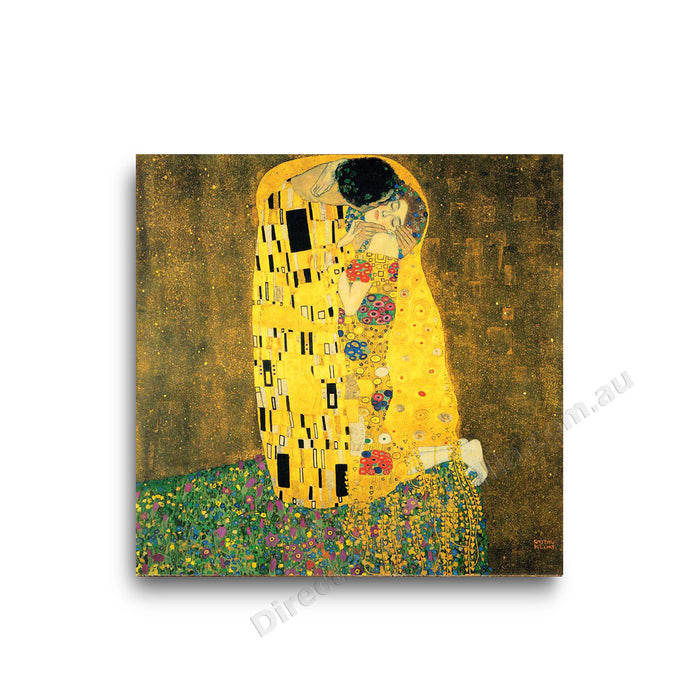
An ornate gold frame is the museum look. It suits Vermeer, Rembrandt, Caravaggio and the Dutch and Italian masters, and a traditional dining room or study. A floating frame suits the same paintings in a modern home, where a heavy moulding would fight the furniture. Klimt, The Kiss is the classic test case: its own gold leaf pattern can carry a Gold Ornate Outer Frame in a formal room, or sit in a Black Floating Frame in a contemporary apartment and look equally at home. Our guide to Klimt's famous paintings covers the square sizes it comes in.

Australian landscapes by Streeton, Roberts and McCubbin split the same way: the Heidelberg School paintings were shown in heavy gold frames in the 1890s, and a Gold Classic Frame honours that, while a Natural Floating Frame makes the same golden paddock feel current.
Can I get a framed canvas print, or only paintings?
Every canvas print in the art prints range offers the same five floating frames as the paintings. The base finish on prints is "Stretched Ready to Hang (FREE)", and the frame is the one upgrade. Prints are printed and framed in Melbourne, so a framed canvas print still arrives within the 10 to 14 day print lead time. Over the Mediterranean II, a blue abstract print, is a good example of a piece that suits a White Floating Frame in a coastal room or a Black Floating Frame in a city apartment.
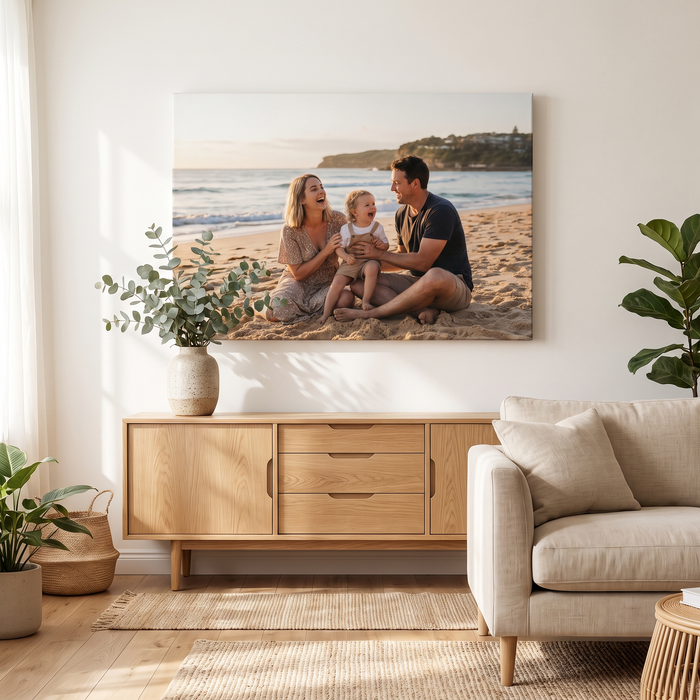
Print Your Own Image on Canvas offers black, gold, silver and white floating frames on five sizes from 40 x 50 cm to 100 x 150 cm, which is the usual route for a family photo or a wedding photo on canvas. Custom portraits painted from your photo are made stretched and ready to hang; if you would like one framed, ask us when you order and we will confirm what suits the size.
For more pieces that take a frame well, browse living room wall art, abstract art and landscape paintings.
Questions people ask
Is a float frame the same as a floating frame?
Yes. Float frame, floater frame and floating picture frame all describe the same thing: a frame with a gap between the canvas and the moulding, used for stretched canvas rather than paper. On our product pages the option is always written "Floating Frame" with the colour in front of it.
Does a canvas floating frame suit a print as well as a painting?
It does, and prints often gain the most from one. A stretched print has a printed edge rather than a painted one, and the frame covers that edge with a clean timber line. The same five colours are available on every print, and the choice follows the same rules as for paintings: match the room first, then the dominant colour of the image.
Do floating frames come with glass?
No. Canvas art is never glazed. The paint or print sits open to the room, which is how oil paintings are meant to be seen, and it means no reflections. Dust the surface with a soft dry cloth and keep it out of direct sun; our guide to cleaning an oil painting covers the rest.
Can I add a floating frame later?
The frame is fitted to the stretched canvas before dispatch, so it is easiest and cheapest to choose it when you order. A local picture framer can fit a floating frame to a stretched canvas later, but the colour match to our own frames is not guaranteed. If you are unsure, order stretched and use the room preview first, or call 1300 90 21 53 and describe the room.
Related guides
- Art above the bed: what size, how high, and one piece or two
- Famous Klimt paintings explained
- How to clean and care for an oil painting at home
Next step: open any painting, choose a size, then pick a floating frame colour under Finish Option to see the frame corner and the price side by side. Browse the hand-painted paintings to start.