In this guide
Gustav Klimt's most famous paintings are The Kiss (1907-08) and Portrait of Adele Bloch-Bauer I (1907), both from his golden phase, when he worked real gold leaf into his paint so figures shimmer against patterned backgrounds. Close behind are The Three Ages of Woman, his square garden landscapes and the bright portraits of his last years. Here is what each one shows, where it hangs today, and how to choose one for your home.
Who was Gustav Klimt?
Gustav Klimt was born near Vienna in 1862 and died in Vienna in 1918. His father was a gold engraver, and Klimt trained at Vienna's School of Applied Arts, starting out painting murals and ceilings for grand public buildings.
In 1897 he co-founded the Vienna Secession, a group of artists who broke away from the city's conservative art establishment, and he became its first president. The Secession wanted art to be modern, decorative and part of everyday life. That thinking runs through everything Klimt painted afterwards: flat pattern beside realistic faces, and ornament treated as seriously as the figure.
What is Klimt's golden phase?
Around the turn of the century Klimt began using gold and silver leaf in his canvases. He saw the gold Byzantine mosaics in Ravenna, Italy, in 1903, and their flat, glittering surfaces fed straight into his work.
The result is a style nobody mistakes for anyone else. Faces and bodies are painted softly and realistically, while clothing, blankets and backgrounds dissolve into spirals, rectangles and flowers. The gold catches the light differently as you walk past, which is a big part of why these paintings feel so alive in person.
The Kiss (1907-08)

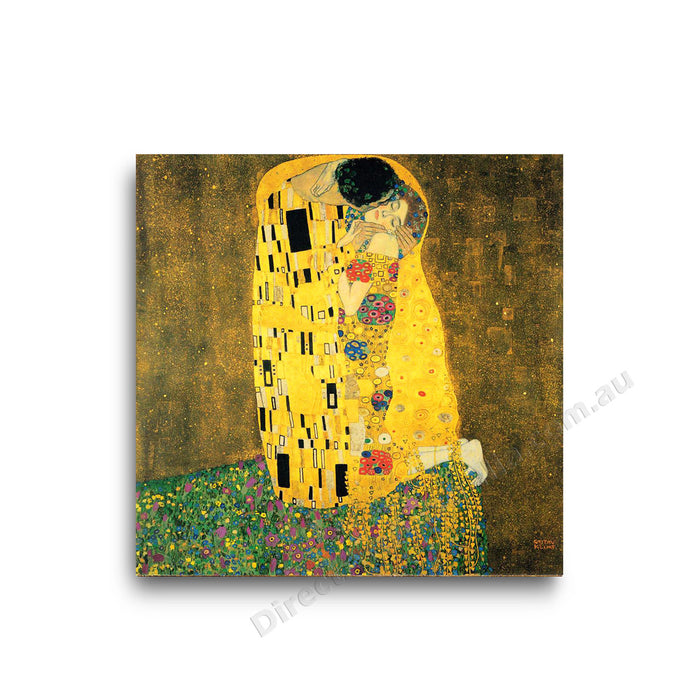
The Kiss shows a couple wrapped together in a single golden cloak, kneeling at the edge of a flowering meadow. His robe is filled with black and white rectangles; hers with circles and flowers. It was bought by the Austrian state in 1908 and hangs today in the Belvedere in Vienna, where it is the museum's best-known work.
Its theme of love makes it a natural choice for a bedroom, a wedding or an anniversary. Like the original, our hand-painted reproduction of The Kiss is square, offered from 60x60 cm up to 175x175 cm.
Portrait of Adele Bloch-Bauer I (1907)

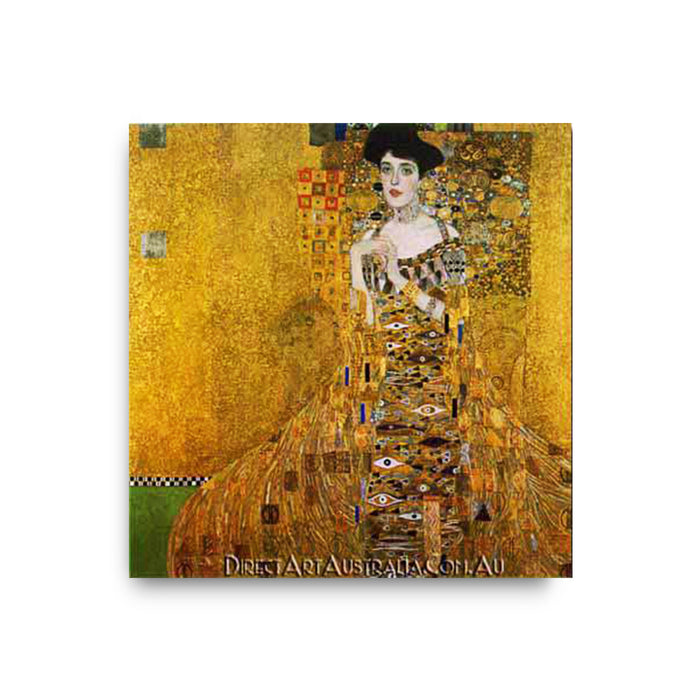
Adele Bloch-Bauer was the wife of a wealthy Viennese sugar industrialist, and her portrait is the high point of the golden phase. Only her face, shoulders and hands are painted naturalistically; the rest of the canvas is a sea of gold pattern.
It also carries one of the art world's best-known stories. The painting was seized by the Nazis after Austria's annexation in 1938 and later hung in the Belvedere for decades. Adele's niece, Maria Altmann, fought the Austrian government for its return, a case that went to the United States Supreme Court. In 2006 an Austrian arbitration panel ruled in her favour. The painting was then bought for the Neue Galerie in New York, where it is on display today. The story was retold in the 2015 film Woman in Gold. Our Adele Bloch-Bauer I reproduction is square, from 60x60 cm to 175x175 cm.
The Three Ages of Woman (1905)
The Three Ages of Woman shows a young mother holding a sleeping child, beside an older woman who turns away with her face hidden. It is a gentle, thoughtful picture about the stages of life, set against a dark, patterned background. The original belongs to the Galleria Nazionale d'Arte Moderna in Rome. Our reproduction of The Three Ages of Woman is also square, from 60x60 cm to 175x175 cm.
Did Klimt paint landscapes?
Yes, and many people are surprised by them. Klimt spent summers at Lake Attersee in Austria, where he painted gardens, orchards and lakeside scenes, almost always on a square canvas.

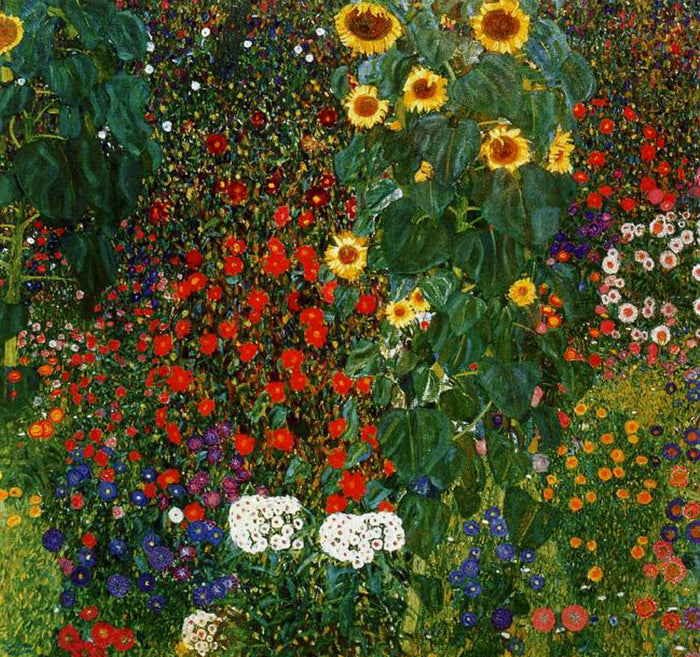
Farm Garden with Sunflower (1906) is a good example, and it hangs in the Belvedere alongside The Kiss. There is no sky and no horizon, just flowers packed edge to edge around one tall sunflower. It uses no gold, but it has the same all-over pattern as his portraits, and it is one of the easiest Klimts to live with. Our Farm Garden with Sunflower reproduction comes in square sizes from 60x60 cm to 175x175 cm.
What did Klimt paint after the golden phase?
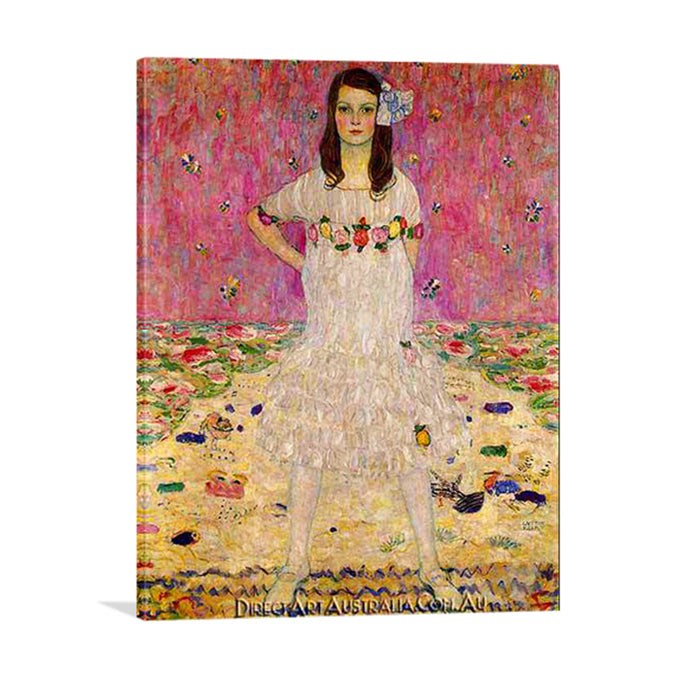
After about 1910 Klimt moved away from gold. His later portraits swap metallic backgrounds for bright colour: pinks, greens, blues and scattered flowers. Portrait of Mada Primavesi (1912-13), showing a young girl standing confidently in a white dress against a floral background, is a well-loved example and belongs to The Metropolitan Museum of Art in New York.
These works suit people who love Klimt's pattern but want something lighter than the golden paintings. Unlike the square works above, our Mada Primavesi reproduction is portrait-shaped (taller than wide), from 50x60 cm to 135x200 cm.
Famous Klimt paintings at a glance
| Painting | Year | Period | Where it hangs today | Our reproduction |
|---|---|---|---|---|
| The Kiss | 1907-08 | Golden phase | Belvedere, Vienna | Square, 60x60 to 175x175 cm |
| Portrait of Adele Bloch-Bauer I | 1907 | Golden phase | Neue Galerie, New York | Square, 60x60 to 175x175 cm |
| The Three Ages of Woman | 1905 | Golden phase | Galleria Nazionale d'Arte Moderna, Rome | Square, 60x60 to 175x175 cm |
| Farm Garden with Sunflower | 1906 | Landscape | Belvedere, Vienna | Square, 60x60 to 175x175 cm |
| Portrait of Mada Primavesi | 1912-13 | Later colourful portraits | The Metropolitan Museum of Art, New York | Portrait, 50x60 to 135x200 cm |
The square sizes are 60x60, 75x75, 90x90, 110x110, 150x150 and 175x175 cm. The portrait sizes are 50x60, 60x90, 75x100, 90x120, 100x150, 120x180 and 135x200 cm. All sizes are the canvas itself.
Which Klimt painting suits my room?
Klimt is decorative by nature, which makes his work unusually easy to place.
- Bedroom: The Kiss is the natural choice above a bed. It is romantic without being loud, and its warm golds sit comfortably with timber, linen and neutral bedding.
- Living room: Portrait of Adele Bloch-Bauer I makes a strong focal point above a sofa or sideboard. For a more relaxed room, Farm Garden with Sunflower brings colour without dominating.
- Entry or hallway: a narrow wall suits a portrait-shaped work such as Portrait of Mada Primavesi, which uses height rather than width.
How do I choose the right size?
Choose the nearest size in the artwork's own shape. As a guide, aim for a painting about two-thirds to three-quarters the width of the furniture beneath it, then pick the closest size that painting offers. Above a queen bed (about 153 cm wide), a square Klimt such as The Kiss sits comfortably at 110x110 cm. Above a king bed (about 183 cm), 110x110 cm gives a lighter look and 150x150 cm a bolder one.
Remember that sizes are the canvas. A floating frame, a slim frame that leaves a small gap around the canvas edge, adds about 2 to 3 cm each side. An ornate or classic frame adds about 8 to 12 cm each side. Our size guide has more room-by-room help, and "See it in your room" on every painting page shows the painting on a photo of your own wall, to scale.
Which finish should I pick?
These Klimt reproductions offer "Rolled in a Tube - Canvas Only (No Frame)", "Stretched Ready to Hang (Gallery Wrap Inner Frame)", where the canvas is pulled around a timber frame so it hangs without an outer frame, five floating frames, and ornate and classic frames such as "Gold Ornate Outer Frame" and "Gold Classic Frame". Gold frames echo the golden phase; the "Black Floating Frame" or "Natural Floating Frame" feels more contemporary. Current prices for each finish are on the product page.
How does the gold look in an oil reproduction?
Klimt's golden-phase originals contain real gold and silver leaf. Our reproductions are hand-painted in oils on canvas by professional, university-trained artists, and the gold areas are painted in layered oil colours chosen to evoke those gold tones. They are not made with gold leaf.
In practice the gold reads as warm and textured rather than mirror-bright. It glows under lamp light and softens in daylight. Screen colours vary, and a hand-painted work will differ slightly from the photo. To see brushwork up close, look at our close-up examples.
Questions people ask
What is Klimt's most famous painting?
The Kiss (1907-08) is his most famous painting. It hangs in the Belvedere in Vienna.
Where is the original Woman in Gold painting now?
Portrait of Adele Bloch-Bauer I, often called the Woman in Gold, is at the Neue Galerie in New York. It was returned to Maria Altmann in 2006 after a long legal fight with Austria.
Do your Klimt reproductions use real gold leaf?
No. They are hand-painted in oils, with the gold areas painted to evoke Klimt's gold tones. Reproductions carry no forged signature and are not artificially aged.
How long does a Klimt painting take to arrive?
Paintings take 21 to 28 days to paint and dispatch, then 3 to 7 business days in transit, with free delivery Australia-wide. Busy periods such as the lead-up to Christmas can run longer. See dispatch and delivery for details.
Related guides
Next step: browse all our Klimt paintings in the Gustav Klimt collection, then use "See it in your room" to check the size on your own wall.