In this guide
The most famous landscape paintings are Constable's The Hay Wain (1821), Turner's The Fighting Temeraire (1839), Friedrich's Wanderer above the Sea of Fog (about 1818), Monet's Impression, Sunrise (1872), Van Gogh's Starry Night (1889) and Bruegel's Hunters in the Snow (1565). Most hang in London, Paris, New York, Hamburg and Vienna; as hand-painted reproductions they come in landscape sizes from 60 x 50 cm to 200 x 135 cm.
Landscape was a backdrop for saints and kings until the 1600s, when Dutch and French painters made the land itself the subject. By the 1800s it was the most ambitious thing a painter could attempt, and the works below are the ones that still fill gallery rooms and living rooms today. For each one we give the year, where it hangs, what to look for, and whether it exists in our range as a hand-painted oil reproduction.
What are the most famous landscape paintings?

Ask ten people to name a landscape painting and most will land on one of the works below. They were painted between 1565 and 1906, in Flanders, England, Germany, France and Japan, and between them they tell the story of how landscape painting grew from careful record-keeping into pure feeling about light and weather.
The table gives the essentials. Each painting is then described in the order most lists rank them, with a link to the museum that holds it and, where we paint it, to the reproduction.
| Painting | Artist | Year | Where it hangs | In our range |
|---|---|---|---|---|
| The Hay Wain | John Constable | 1821 | National Gallery, London | Yes, landscape shape |
| Wanderer above the Sea of Fog | Caspar David Friedrich | about 1818 | Hamburger Kunsthalle, Hamburg | No |
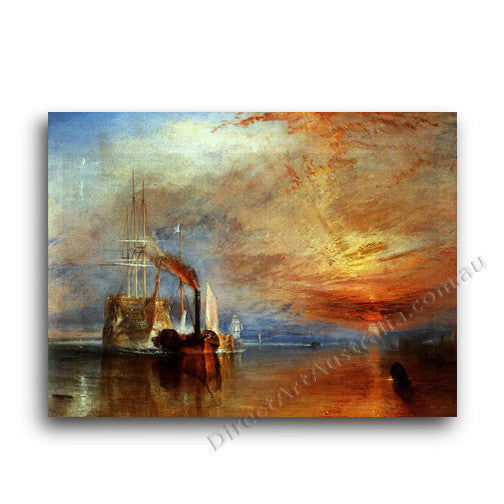
| The Fighting Temeraire | J.M.W. Turner | 1839 | National Gallery, London | Yes, landscape shape |
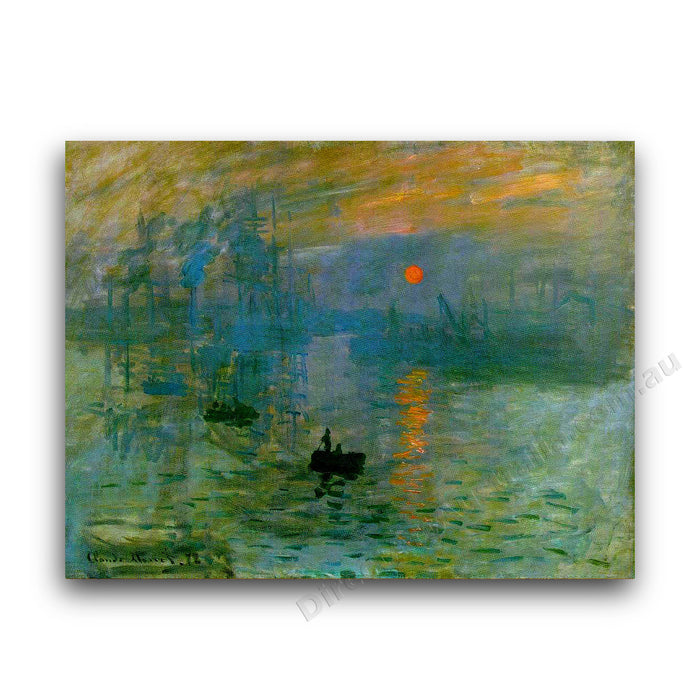
| Impression, Sunrise | Claude Monet | 1872 | Musée Marmottan Monet, Paris | Yes, landscape shape |
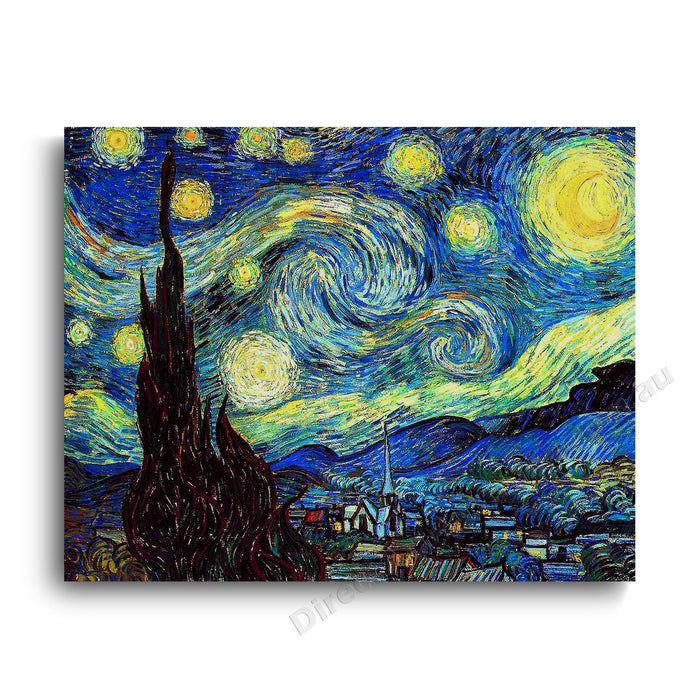
| Starry Night | Vincent van Gogh | 1889 | Museum of Modern Art, New York | Yes, landscape shape |
| Wheat Field with Cypresses | Vincent van Gogh | 1889 | Metropolitan Museum of Art, New York, and National Gallery, London | Yes, landscape shape |
| Hunters in the Snow | Pieter Bruegel the Elder | 1565 | Kunsthistorisches Museum, Vienna | No |
| Mont Sainte-Victoire | Paul Cézanne | 1880s to 1906 | Many museums, including the Courtauld Gallery, London | Yes, six sizes |
| Norham Castle, Sunrise | J.M.W. Turner | about 1845 | Tate Britain, London | Yes, landscape shape |
| The Great Wave off Kanagawa | Katsushika Hokusai | about 1831 | Woodblock print; impressions in many museums | No |
Every reproduction in our masterpiece range is 100% hand-painted in oils on canvas by a professional, university-trained artist, carries no forged signature and is not artificially aged. The landscape-shaped works are offered in seven sizes: 60 x 50, 90 x 60, 100 x 75, 120 x 90, 150 x 100, 180 x 120 and 200 x 135 cm. Each size is the canvas, width by height.
The Hay Wain (John Constable, 1821)
A hay cart stands in the shallows of the River Stour at Flatford, Suffolk, with Willy Lott's cottage on the left and a sky full of moving cloud. Constable painted it in London from sketches made on the spot, and when it was shown at the Paris Salon of 1824 it won a gold medal and influenced a generation of French painters. It hangs in the National Gallery, London. Our John Constable | The Hay Wain is landscape-shaped, 60 x 50 cm to 200 x 135 cm, and was made for a gold frame.
Wanderer above the Sea of Fog (Caspar David Friedrich, about 1818)
A man in a dark coat stands on a rocky outcrop with his back to us, looking over a valley filled with mist. It is the defining image of German Romanticism: nature as something vast, and the viewer as a small figure within it. The painting belongs to the Hamburger Kunsthalle in Hamburg. It is one of three works on this list we do not offer as a reproduction, and we have kept it in because no list of famous landscapes is complete without it.
The Fighting Temeraire (J.M.W. Turner, 1839)
The old warship HMS Temeraire, which fought at Trafalgar in 1805, is towed up the Thames by a small steam tug to be broken up, under a blazing sunset. Turner never sold it and left it to the nation, and in a 2005 BBC poll it was voted Britain's favourite painting. It hangs in the National Gallery, London, and since 2020 it has appeared on the Bank of England 20 pound note. Our J.M.W. Turner | The Fighting Temeraire is landscape-shaped, 60 x 50 cm to 200 x 135 cm.
Impression, Sunrise (Claude Monet, 1872)
A small orange sun rises over the harbour at Le Havre, its reflection broken on the water, with two rowing boats in silhouette and the port's cranes dissolving into blue mist. Shown in Paris in 1874, its title gave the Impressionists their name after a critic used the word as a joke. It hangs at the Musée Marmottan Monet in Paris. Our Monet | Impression, Sunrise is landscape-shaped, 60 x 50 cm to 200 x 135 cm, and our guide to Monet's famous paintings tells the story in more detail.
Starry Night (Vincent van Gogh, 1889)
Van Gogh painted the view from his window at the asylum in Saint-Rémy-de-Provence in June 1889, adding the swirling sky and the dark cypress from imagination. It has been at the Museum of Modern Art in New York since 1941 and is one of the most recognised paintings in the world. Our Vincent van Gogh | Starry Night is landscape-shaped, 60 x 50 cm to 200 x 135 cm. The Van Gogh guide covers the painting and its companions.
Wheat Field with Cypresses (Vincent van Gogh, 1889)
Painted the same summer at Saint-Rémy, this is Van Gogh's daytime answer to Starry Night: a ripe wheat field, two dark cypresses and a sky of rolling white cloud. He painted three versions; one is at the Metropolitan Museum of Art in New York and another at the National Gallery, London. Our Vincent van Gogh | Wheat Field with Cypresses is landscape-shaped, 60 x 50 cm to 200 x 135 cm.
Hunters in the Snow (Pieter Bruegel the Elder, 1565)
Three hunters and their dogs trudge home over a snowy hill while villagers skate on the frozen ponds below. It is part of a series of the months and one of the first great winter landscapes in Western art. It hangs in the Kunsthistorisches Museum in Vienna. We do not offer it as a reproduction.
Mont Sainte-Victoire (Paul Cézanne, 1880s to 1906)
Cézanne painted the limestone mountain outside Aix-en-Provence dozens of times over nearly 30 years, building the valley from blocks of colour in a way that pointed straight towards Cubism. Versions hang in many museums, including the Courtauld Gallery in London. Our Paul Cezanne | Mont Sainte-Victoire is offered in six sizes from 50 x 60 cm to 90 x 120 cm.
Norham Castle, Sunrise (J.M.W. Turner, about 1845)
Late in life Turner returned to a castle on the River Tweed he had first painted as a young man, and reduced it to a blue shadow floating in gold light, with a cow drinking in the foreground. It was never exhibited in his lifetime and is now at Tate Britain. Our J.M.W. Turner | Norham Castle, Sunrise is landscape-shaped, 60 x 50 cm to 200 x 135 cm, and is the quietest painting on this list, which makes it a natural fit for a bedroom.
The Great Wave off Kanagawa (Katsushika Hokusai, about 1831)
Strictly a woodblock print rather than a painting, the Great Wave belongs in any list of famous landscapes: a giant wave about to break over three boats, with Mount Fuji small and still in the distance. Impressions are held by museums around the world. It is not in our range.
Who are the most famous landscape artists?

Landscape artists tend to be grouped by the century they worked in and by the way they treated light. The names below come up in every survey of landscape painting artists, and most of them are represented in our 50 most famous paintings collection.
If you are choosing a painting for a particular room, the groupings are a useful shortcut. The Romantics give you drama and suit a gold frame. The Impressionists give you colour and light. The Post-Impressionists give you structure and bold shape. Before all of them, the Dutch painter Jacob van Ruisdael (about 1629 to 1682) and the French painter Claude Lorrain (about 1600 to 1682) set the pattern that every later landscape answers.
Romanticism paintings: Constable, Turner and Friedrich
In the early 1800s John Constable (1776 to 1837) painted the Suffolk countryside he grew up in with a truthfulness to weather that was new. J.M.W. Turner (1775 to 1851) went the other way, dissolving ships, castles and mountains into storms of light. In Germany, Caspar David Friedrich (1774 to 1840) painted mist, ruins and lone figures as a way of talking about faith and solitude. Browse our John Constable paintings and J.M.W. Turner paintings.
Impressionism and after: Monet, Van Gogh and Cézanne
Claude Monet (1840 to 1926) took the easel outdoors and painted the same haystacks, cathedral fronts and lily ponds again and again to catch the changing light. Vincent van Gogh (1853 to 1890) used thick, rhythmic strokes that make a wheat field or a night sky seem to move. Paul Cézanne (1839 to 1906) slowed everything down, building his mountain from patient planes of colour. See the Claude Monet paintings, Vincent van Gogh paintings and Paul Cézanne paintings collections.
Which Australian landscape painters are famous?

The famous Australian landscape paintings most people know come from the Heidelberg School, the group of young Melbourne painters who in the late 1880s and 1890s worked outdoors at Box Hill, Mentone and Eaglemont and painted the bush in its own hard light. Arthur Streeton, Tom Roberts and Frederick McCubbin are the three names to remember.
Streeton (1867 to 1943) is the great Australian painter of heat and distance. Golden Summer, Eaglemont (1889) is at the National Gallery of Australia in Canberra, and Near Heidelberg (1890), a tall gum on a golden hillside, is at the National Gallery of Victoria. Our Streeton | Near Heidelberg is portrait-shaped, 50 x 60 cm to 135 x 200 cm, and Streeton | Land of Golden Fleece, his 1926 view of the Western District of Victoria, is landscape-shaped, 60 x 50 cm to 200 x 135 cm.
Later, Albert Namatjira (1902 to 1959) painted the ranges and ghost gums of Central Australia in watercolour and became one of the best-known Australian artists of his time. His work is not in our range. For the full story of the Heidelberg School, and the paintings by Roberts and McCubbin that go with it, read our guide to famous Australian paintings, or browse the Arthur Streeton paintings and the wider Australian art collection.
What size should a famous landscape painting be, and which frame suits it?
Start with the furniture under the wall. A landscape painting looks right at about two thirds the width of the sofa, sideboard or bed below it, hung with its centre about 145 to 150 cm from the floor. Above a 200 cm sofa that points to 120 x 90 cm or 150 x 100 cm; above a queen bed, 100 x 75 cm or 120 x 90 cm.
Sizes depend on the shape of the artwork, so check the product page rather than assuming. Most works on this list are landscape-shaped. Near Heidelberg is portrait-shaped, and Mont Sainte-Victoire has its own set of sizes.
| Painting | Shape | Sizes offered (cm) | Frame that suits it |
|---|---|---|---|
| The Hay Wain | Landscape | 60 x 50 to 200 x 135 | Gold Classic Frame or Gold Ornate Outer Frame |
| The Fighting Temeraire | Landscape | 60 x 50 to 200 x 135 | Gold Ornate Outer Frame or Dark Brown with Gold Inner |
| Impression, Sunrise | Landscape | 60 x 50 to 200 x 135 | Gold Floating Frame or Gold Classic Frame |
| Starry Night | Landscape | 60 x 50 to 200 x 135 | Black Floating Frame or Modern Flat Black Frame |
| Wheat Field with Cypresses | Landscape | 60 x 50 to 200 x 135 | Natural Floating Frame or Gold Floating Frame |
| Mont Sainte-Victoire | Mixed | 50 x 60, 75 x 75, 60 x 90, 75 x 100, 90 x 90, 90 x 120 | Natural Floating Frame or Modern Flat Gold Frame |
| Norham Castle, Sunrise | Landscape | 60 x 50 to 200 x 135 | Gold Classic Frame or White Floating Frame |
| Near Heidelberg | Portrait | 50 x 60 to 135 x 200 | Natural Floating Frame or Gold Classic Frame |
The frame changes the look as much as the size. A Gold Classic Frame or Gold Ornate Outer Frame suits Constable and Turner, whose paintings were made for exactly that kind of frame, and adds about 8 to 12 cm to each side. Monet, Van Gogh and Cézanne sit well in a slim Gold, Black or Natural Floating Frame, which adds about 2 to 3 cm per side; our floating frame guide explains the difference. "Stretched Ready to Hang (Gallery Wrap Inner Frame)" gives a clean, frameless look, and "Rolled in a Tube - Canvas Only (No Frame)" suits anyone with their own framer.
Use the size guide to compare the shapes side by side, and See it in your room to place any painting on a photo of your own wall, to scale. Our close-up examples show the brushwork you can expect, and the painting process page explains how each reproduction is made. Screen colours vary, and a hand-painted work will differ slightly from the photo on the product page.
Hand-painted paintings take 21 to 28 days to make, and busy periods such as the lead-up to Christmas can run longer. If the painting is a Christmas gift, check the current dates on our Christmas order-by page before you order. Delivery is free Australia-wide and every painting carries a 30-day money-back guarantee. If you would rather have a print, the landscape canvas prints collection is printed, stretched and framed in Melbourne in 10 to 14 days.
Questions people ask
What is plein air painting?
Plein air is French for "in the open air": painting outdoors in front of the subject rather than indoors from sketches. Paint sold in portable metal tubes from the 1840s made it practical, and the Impressionists and the Heidelberg School built their whole approach on it. Constable's cloud studies were plein air work; The Hay Wain itself was finished indoors.
What are the most famous water paintings?
Monet's Impression, Sunrise and his Water Lilies series, Hokusai's The Great Wave off Kanagawa, Turner's The Fighting Temeraire and Constable's The Hay Wain are the water scenes that appear on most lists. For a wall, Impression, Sunrise and The Fighting Temeraire are both landscape-shaped and both available as hand-painted reproductions.
Is Starry Night a landscape painting?
Yes. It shows a real view, the village and hills seen from Van Gogh's window at Saint-Rémy, with the sky and the cypress heightened from imagination. Art historians class it as a landscape, and more precisely as a nocturne, a night scene.
Are your famous landscape paintings prints or paintings?
They are paintings. Every work in our masterpiece range is 100% hand-painted in oils on canvas by a professional, university-trained artist, then stretched and framed in Melbourne. Canvas prints are sold separately in the landscape prints collection and are always labelled as prints.
Related guides
- Famous Van Gogh paintings explained: Starry Night, Sunflowers, Almond Blossom
- Famous Monet paintings explained: Water Lilies, Impression Sunrise, Haystacks
- Famous Australian paintings: the Heidelberg School works every Australian knows
Next step: browse the landscape paintings collection, or go straight to The Hay Wain and use See it in your room to try it on your own wall.