In this guide
The most famous Van Gogh paintings are The Starry Night (1889), Sunflowers (1888 to 1889), Almond Blossom (1890), Cafe Terrace at Night (1888), Irises (1889) and The Bedroom (1888). Almost all of them come from his last three years, in Arles and Saint-Rémy. We hand-paint each one in oils, in sizes from 50 x 60 cm up to 200 x 135 cm, in 21 to 28 days.
What are the most famous Van Gogh paintings?

Vincent van Gogh lived from 1853 to 1890 and painted for only about ten years. The pictures people know best were nearly all made in the final stretch: from February 1888 in Arles in the south of France, then in the asylum at Saint-Rémy-de-Provence, and finally in Auvers-sur-Oise, where he died in July 1890.
That short window explains why so many of his famous works share the same thick, directional brushstrokes, yellows and blues. If you are choosing one for a wall, it helps to know what each painting is, where the real one hangs and what shape the canvas is, because shape decides which sizes you can order.
Here is a quick reference for the ten works most people ask us about.
| Painting | Year | Painted in | Where it hangs today | Canvas shape |
|---|---|---|---|---|
| The Starry Night | 1889 | Saint-Rémy | Museum of Modern Art, New York | Landscape |
| Sunflowers | 1888 to 1889 | Arles | Several versions, including the National Gallery, London and the Van Gogh Museum, Amsterdam | Portrait |
| Almond Blossom | 1890 | Saint-Rémy | Van Gogh Museum, Amsterdam | Landscape |
| Cafe Terrace at Night | 1888 | Arles | Kröller-Müller Museum, Otterlo | Portrait |
| Irises | 1889 | Saint-Rémy | J. Paul Getty Museum, Los Angeles | Landscape |
| The Bedroom | 1888 | Arles | Three versions: Amsterdam, Chicago and Paris | Landscape |
| Starry Night Over the Rhône | 1888 | Arles | Musée d'Orsay, Paris | Landscape |
| Wheatfield with Crows | 1890 | Auvers-sur-Oise | Van Gogh Museum, Amsterdam | Panoramic |
| Self portraits | 1886 to 1889 | Paris, Arles, Saint-Rémy | Many collections | Portrait |
| The Potato Eaters | 1885 | Nuenen, Netherlands | Van Gogh Museum, Amsterdam | Landscape |
What is the Starry Night meaning?
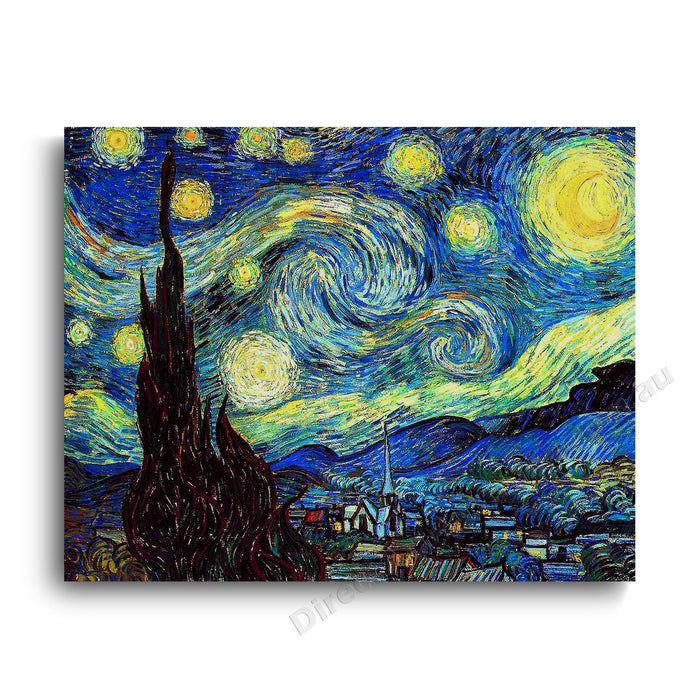
Van Gogh painted The Starry Night in June 1889, a few weeks after he admitted himself to the asylum at Saint-Rémy. The view is based on what he saw from his east-facing window before sunrise, but the village and its church spire were largely imagined, and the sky is far more alive than any real one.
There is no single agreed Starry Night meaning, and you should be wary of anyone who offers one. What his letters show is that he loved the night sky as a subject and found comfort in it. The tall cypress in the foreground, a tree linked with graveyards in southern France, rises to meet the stars, which many viewers read as a quiet link between life, death and something larger.
What everyone agrees on is the feeling: movement and calm at the same time. That is why it works on a wall. The blues sit happily with grey, white and timber interiors, and the landscape shape suits a sofa or a bed. Our Starry Night reproduction comes in 60 x 50, 90 x 60, 100 x 75, 120 x 90, 150 x 100, 180 x 120 and 200 x 135 cm.
Starry Night Over the Rhone (1888)
People often mix the two night skies up. Starry Night Over the Rhône came first, in September 1888, painted on the riverbank in Arles with gas lamps reflecting in the water and a couple strolling in the foreground. It is calmer and more literal than the 1889 picture, and it hangs at the Musée d'Orsay in Paris.
Van Gogh Sunflowers: why did he paint so many?

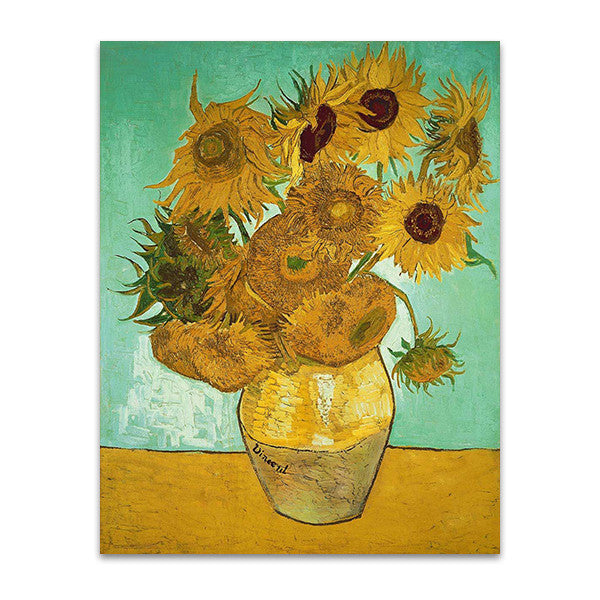
In August 1888 Van Gogh was renting the Yellow House in Arles and waiting for the painter Paul Gauguin to join him. He painted a series of sunflowers in a vase to decorate the room Gauguin would sleep in, then made further versions of the best ones in early 1889.
That is why there are several Sunflowers rather than one. The best known hang in the National Gallery in London and the Van Gogh Museum in Amsterdam. They are almost entirely yellow on yellow, which was a bold experiment at the time, and the flowers are shown at every stage from fresh to wilting.
For a home, the Van Gogh Sunflowers are a warm, cheerful choice for a kitchen, dining room or entry. The canvas is portrait shaped, so our Sunflowers reproduction comes in 50 x 60, 60 x 90, 75 x 100, 90 x 120, 100 x 150, 120 x 180 and 135 x 200 cm. A Gold Floating Frame suits the yellows well.
Van Gogh Almond Blossom: what is the story behind it?

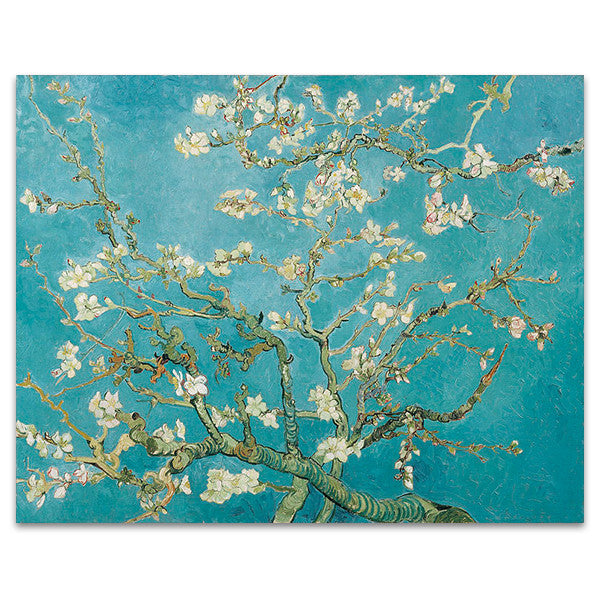
Almond Blossom is a painting made for a baby. In January 1890 Vincent's brother Theo and his wife Jo had a son, and they named him Vincent Willem after his uncle. Van Gogh, still at Saint-Rémy, painted branches of white almond blossom against a clear blue sky to hang above the child's bed.
Almond trees flower early in the south of France, so the blossom stands for new life. You can see the influence of Japanese prints, which he collected, in the flat background and the strong outlines of the branches. The family kept the painting, and it is now in the Van Gogh Museum in Amsterdam.
Because of that story, Almond Blossom is a thoughtful gift for a new baby, a christening or a new grandparent, and its soft turquoise sits easily in a bedroom. The Almond Blossom reproduction is landscape: 60 x 50 cm through to 200 x 135 cm.
Which other famous Van Gogh paintings are worth knowing?
Beyond the big three, these are the works people search for most, and each has a story worth knowing before it goes on your wall.
Cafe Terrace at Night (1888)
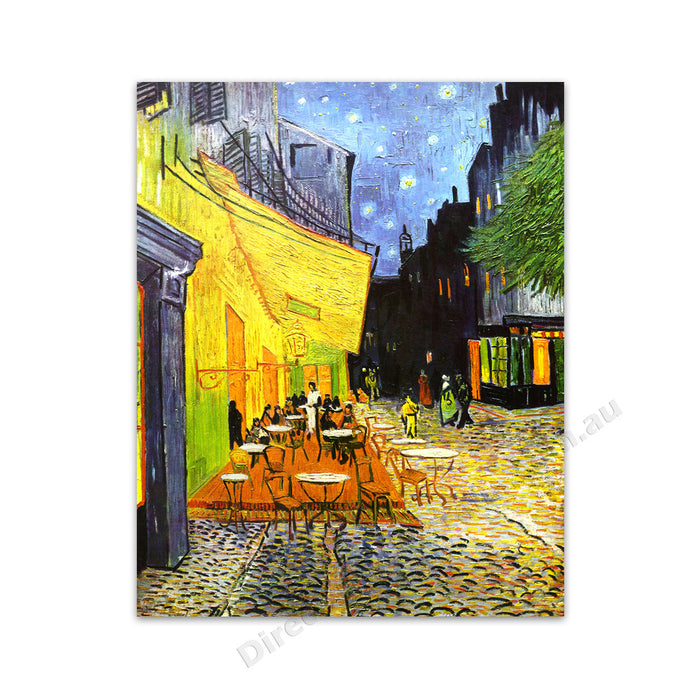
Painted in September 1888 on the Place du Forum in Arles, this shows a cafe lit by a gas lamp under a deep blue, star-filled sky. It was one of his first night scenes, painted on the spot rather than in the studio. It hangs at the Kröller-Müller Museum in the Netherlands. The Cafe Terrace at Night reproduction is portrait, from 50 x 60 cm to 135 x 200 cm, and suits a narrow wall or hallway.
Van Gogh Irises (1889)
Van Gogh painted Irises in May 1889, in his first week at the Saint-Rémy asylum, working from the flowerbeds in its garden. One white iris stands out among the blue, a detail people love to point out. The painting belongs to the J. Paul Getty Museum in Los Angeles.
Van Gogh Bedroom in Arles (1888)
The Bedroom shows his own room in the Yellow House, with its wooden bed, two chairs and pictures on the wall. He said he wanted it to suggest rest. He painted three versions, now in Amsterdam, Chicago and Paris. Our Vincent's Bedroom in Arles reproduction is landscape, 60 x 50 cm to 200 x 135 cm.
Van Gogh Self Portrait (1886 to 1889)
Van Gogh painted more than 35 self portraits, many in Paris, partly because he could not afford models. They are the best record of how quickly his style changed. If you like the idea of a portrait with that loose, visible brushwork, our artists can paint your own family or pet from a photo in the Impressionist style with a custom oil portrait.
Van Gogh Wheatfield with Crows (1890)
Painted in July 1890 at Auvers-sur-Oise, this long, stormy field under black birds is often called his last painting. Historians do not agree on that, so treat the story with care. It hangs in the Van Gogh Museum.
Van Gogh famous paintings for your walls: which size and which room?
Every reproduction is sized by its shape, and the finish you pick adds a little. A floating frame adds about 2 to 3 cm per side, and an ornate or classic frame about 8 to 12 cm. Here is how the main works line up.
| Painting | Sizes available (cm) | Works well in | Frame idea |
|---|---|---|---|
| Starry Night | 60 x 50 to 200 x 135 | Living room, above a bed | Black Floating Frame |
| The Sunflowers | 50 x 60 to 135 x 200 | Kitchen, dining room, entry | Gold Floating Frame |
| Almond Blossom | 60 x 50 to 200 x 135 | Bedroom, nursery | White Floating Frame |
| Cafe Terrace at Night | 50 x 60 to 135 x 200 | Hallway, narrow wall | Gold Classic Frame |
| Vincent's Bedroom in Arles | 60 x 50 to 200 x 135 | Study, guest room | Natural Floating Frame |
As a rule, art above a sofa or bed should be about two thirds of the furniture's width, so a 2 metre sofa suits a 120 x 90 or 150 x 100 cm landscape. Our size guide walks through the maths, and the See it in your room tool places the painting on a photo of your own wall, to scale.
These are masterpiece reproductions, so the base option is Rolled in a Tube - Canvas Only (No Frame). Choose Stretched Ready to Hang (Gallery Wrap Inner Frame) to hang it straight away, or add a floating or ornate frame. Our floating frame guide explains the colours.
How are our Van Gogh reproductions made?
Every Van Gogh in our range is 100% hand-painted in oils on canvas by professional, university-trained artists. Nothing printed is sold as a painting. Van Gogh's thick impasto is the hardest part to copy, so our artists build the paint up in layers to follow the direction of his brushstrokes. You can see what that looks like on our close-up examples page and read the steps on how we paint.
Paintings take 21 to 28 days to make, and busy periods such as the lead-up to Christmas can run longer. Delivery is free Australia-wide, and every order is covered by our 30-day money-back guarantee. Reproductions carry no forged signature and are not artificially aged.
You will find every work mentioned here, and many more, in our Van Gogh paintings collection. If you are still deciding between artists, browse the wider masterpiece reproductions or ideas for living room art.
Questions people ask
What is the most famous Van Gogh painting?
The Starry Night, painted in June 1889 at Saint-Rémy and held by the Museum of Modern Art in New York, is the one most people recognise. Sunflowers and Almond Blossom are close behind.
Is Almond Blossom Van Gogh's painting for a baby?
Yes. Van Gogh painted Almond Blossom in early 1890 to celebrate the birth of his nephew, Vincent Willem, the son of his brother Theo. It was meant to hang above the baby's bed, which is why it is a popular choice for nurseries and new-baby gifts.
How long does a hand-painted Van Gogh reproduction take?
Hand-painted reproductions take 21 to 28 days to make. Busy periods can run longer. Delivery anywhere in Australia is free, and you have 30 days to return it for a full refund if it is not right.
Can I order a Van Gogh painting in time for Christmas?
Order hand-painted paintings by Tuesday 10 November to allow for the make time and the Christmas rush. After that, a gift card from $50 to $2,000 lets them choose their own Van Gogh in the new year.
Related guides
- Famous Klimt Paintings Explained: The Kiss, Adele Bloch-Bauer and the Golden Phase
- Famous Australian Paintings: The Heidelberg School Works Every Australian Knows
- Art Above the Bed: What Size, How High, and One Piece or Two
Next step: Browse the full Van Gogh collection and use See it in your room to try your favourite on your own wall.