In this guide
The most famous Frida Kahlo paintings are The Two Fridas (1939), Self-Portrait with Thorn Necklace and Hummingbird (1940), The Broken Column (1944), The Wounded Deer (1946) and Viva la Vida, Watermelons (1954). Most are self-portraits about pain, identity and her marriage to Diego Rivera. Hand-painted reproductions come in portrait sizes from 50 x 60 cm to 135 x 200 cm.
Which Frida Kahlo paintings are the most famous?

Frida Kahlo (1907 to 1954) painted for about 30 years, mostly from her family home, the Casa Azul in Coyoacán, Mexico City. She left a body of work of fewer than 200 paintings, and more than 50 of them are self-portraits.
A handful of those pictures have become the images people mean when they say "a Frida". The Two Fridas and Self-Portrait with Thorn Necklace and Hummingbird are the two most reproduced. The Broken Column and The Wounded Deer are the ones people remember for their honesty about her injuries. Viva la Vida, Watermelons is her last painting, and Frieda and Diego Rivera is her wedding portrait.
All of them are in our Frida Kahlo paintings collection, painted by hand in oils, alongside the wider range of masterpiece reproductions.
What makes Frida Kahlo art so recognisable?
Three things: the level, unsmiling gaze under joined eyebrows; the Tehuana dresses, flowers braided into her hair, monkeys and parrots; and her honesty about her own body.
At 18, Kahlo was badly hurt when the bus she was riding collided with a tram. She began painting while confined to bed, using a mirror fitted above her, which is part of why she turned to her own face so often. She lived with pain and repeated surgery for the rest of her life, and much of her work shows it plainly.
She is often grouped with the Surrealists, but she rejected the label, saying she never painted dreams, only her own reality. Her flat backgrounds, small scale and inscriptions owe more to Mexican folk painting and church ex-voto panels than to Paris.
What do the famous Frida Kahlo paintings mean?

Kahlo packed her paintings with symbols. Here is what to look for in the six that matter most, in the order she painted them.
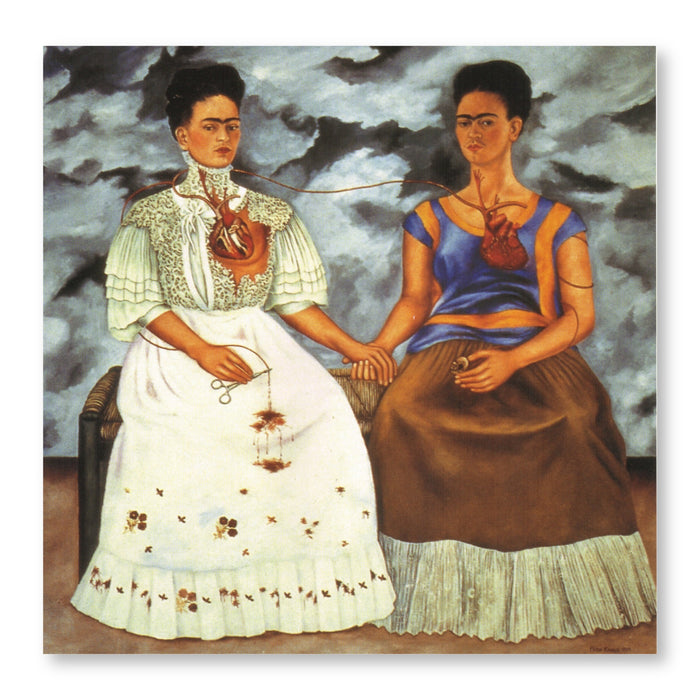
Many of her works are small, some not much bigger than a book page. The Two Fridas is the exception, at about 1.7 metres a side.
Frieda and Diego Rivera (1931)
Painted in San Francisco two years after the couple married, this is a wedding portrait in the folk style. Rivera, a giant beside her, holds his palette and brushes; Kahlo, tiny in a green dress and red shawl, holds his hand. A dove above them carries a ribbon with a dedication. It belongs to the San Francisco Museum of Modern Art.
The Two Fridas (1939)
Painted the year Kahlo and Rivera divorced, The Two Fridas shows two versions of the artist seated hand in hand. The Frida in a white European dress has her heart cut open; the Frida in Tehuana dress holds a tiny portrait of Rivera. A single vein joins their hearts, and the European Frida clamps its end with surgical forceps while blood drips onto her skirt. It hangs in the Museo de Arte Moderno in Mexico City.
Self-Portrait with Thorn Necklace and Hummingbird (1940)
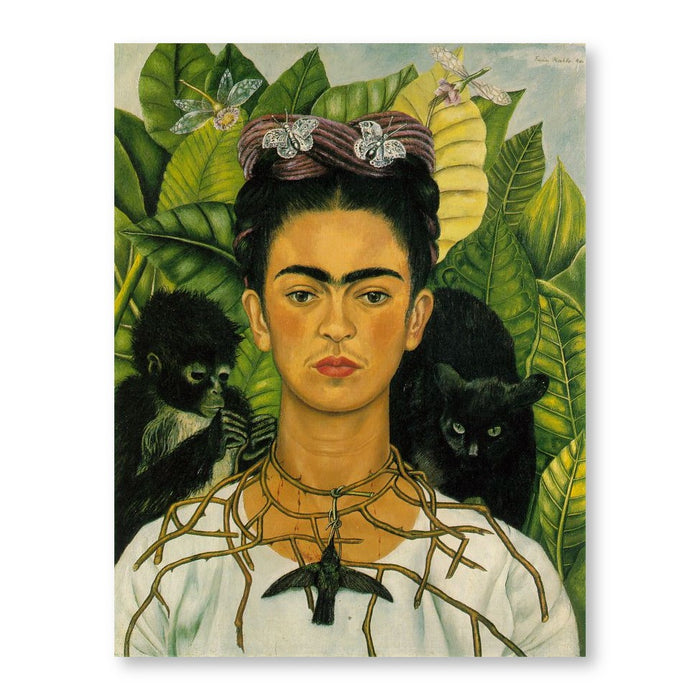
Kahlo wears a necklace of thorns that pricks her neck, with a dead black hummingbird hanging from it like a pendant, a folk charm for luck in love. A black cat waits over one shoulder and a spider monkey, a pet from Rivera, plays with the thorns over the other. Butterflies and dragonflies sit in her hair. The painting is held by the Harry Ransom Center at the University of Texas at Austin.
Self-Portrait with Cropped Hair (1940)
Painted after the divorce, Kahlo sits in an oversized man's suit holding scissors, with her cut hair scattered across the floor around her chair. It belongs to the Museum of Modern Art in New York.
The Broken Column (1944)
Here Kahlo's body opens to show a cracked stone column where her spine should be, held together by a steel surgical corset. Nails are driven into her skin, tears run down her face, and the landscape behind is bare and split. The Broken Column is in the Museo Dolores Olmedo in Mexico City.
The Wounded Deer (1946)
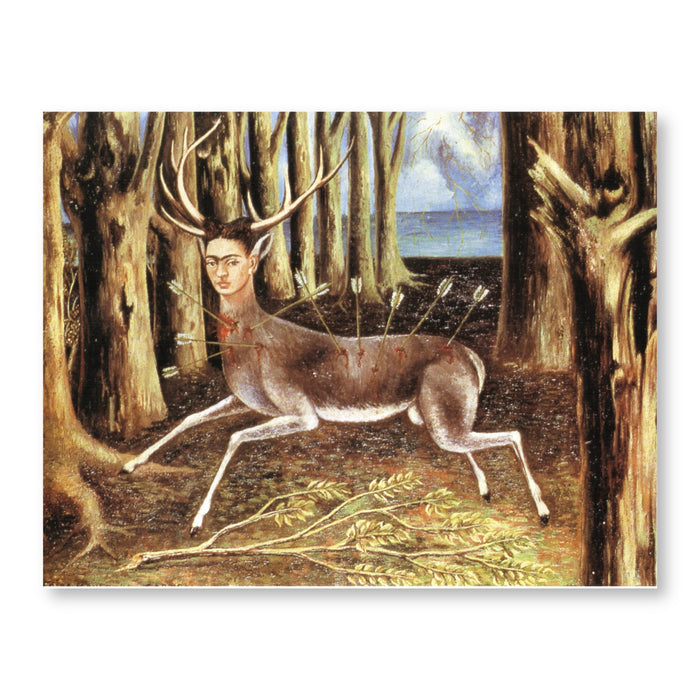
Painted after spinal surgery in New York, The Wounded Deer gives a young stag Kahlo's own head, pierced by nine arrows as it stands in a forest of broken trees. It is held in a private collection.
Where are Frida Kahlo's paintings today?
Most of her key works are in Mexico City, with a few in the United States. This table puts them side by side.
| Painting | Year | Held by | What to look for |
|---|---|---|---|
| Frieda and Diego Rivera | 1931 | San Francisco Museum of Modern Art | The dove and ribbon, the difference in scale |
| Self-Portrait with Monkey | 1938 | Buffalo AKG Art Museum, New York State | The monkey's arm around her neck |
| The Two Fridas | 1939 | Museo de Arte Moderno, Mexico City | The shared vein and the surgical forceps |
| Self-Portrait with Thorn Necklace and Hummingbird | 1940 | Harry Ransom Center, Austin | The hummingbird pendant, cat and monkey |
| Self-Portrait with Cropped Hair | 1940 | Museum of Modern Art, New York | The man's suit and the hair on the floor |
| The Broken Column | 1944 | Museo Dolores Olmedo, Mexico City | The stone column and steel corset |
| The Wounded Deer | 1946 | Private collection | Nine arrows, her face on the deer |
| Viva la Vida, Watermelons | 1954 | Museo Frida Kahlo (Casa Azul), Mexico City | The words "Viva la Vida" on the red flesh |
Viva la Vida, Watermelons deserves a note of its own. It is a bright still life of cut watermelons, and Kahlo inscribed "Viva la Vida" (long live life) into the fruit only days before she died in July 1954. It is the gentlest painting on the list.
What size Frida Kahlo painting suits your wall?
The Kahlo reproductions in this guide are painted in portrait orientation, and the sizes offered are 50 x 60, 60 x 90, 75 x 100, 90 x 120, 100 x 150, 120 x 180 and 135 x 200 cm (width x height). Because her compositions are dense with detail, going up a size usually helps: a face and a necklace of thorns read far better at 75 cm wide than at 50.
| Where it will hang | Suggested canvas size | Why |
|---|---|---|
| Hallway, beside a door or above a small desk | 50 x 60 or 60 x 90 cm | Narrow walls need a narrow piece, and you view it up close |
| Bedroom wall or above a sideboard up to 150 cm wide | 75 x 100 or 90 x 120 cm | Fills the space without crowding the furniture |
| Living room feature wall or above a three-seater sofa | 100 x 150 or 120 x 180 cm | Holds its own from across the room |
| Stairwell or a high-ceilinged room | 135 x 200 cm | A true statement piece at near life size |
Before you choose, measure the wall and try a size with See it in your room, which places the painting on a photo of your own wall, to scale. Our size guide covers spacing above furniture and hanging height, and the living room art collection has pieces that pair well beside a Kahlo.
How is a hand-painted Kahlo reproduction made and framed?
Each painting is 100% hand-painted in oils on canvas by a professional, university-trained artist working from a high-resolution image of Kahlo's work. Nothing is printed and painted over. You can see how that works on our painting process page, and compare brushwork up close on the close-up examples page. Reproductions carry no forged signature and are not artificially aged.
Kahlo reproductions sit in our masterpiece range, so the finish options are wider than usual:
- Rolled in a Tube - Canvas Only (No Frame), if you plan to frame it yourself.
- Stretched Ready to Hang (Gallery Wrap Inner Frame), the clean, frameless look.
- Floating frames in Gold, Black, Silver, Natural or White, which add about 2 to 3 cm per side.
- Ornate and classic frames such as Gold Ornate Outer Frame, Gold Classic Frame or Ornate Silver Frame, which add about 8 to 12 cm per side.
A gold floating frame suits the warm reds and greens of The Two Fridas and Viva la Vida. A black floating frame sharpens the darker palette of The Wounded Deer and The Broken Column.
Paintings take 21 to 28 days to make, and busy periods can run longer. If one is a Christmas present, aim to order by about 10 November. If time is short, a gift card from $50 to $2,000 lets them choose their own Frida in the new year, and our Christmas gifts for art lovers page has more ideas. Every order has free delivery Australia-wide and our 30-day money-back guarantee.
Can I have my own portrait painted in Kahlo's spirit?

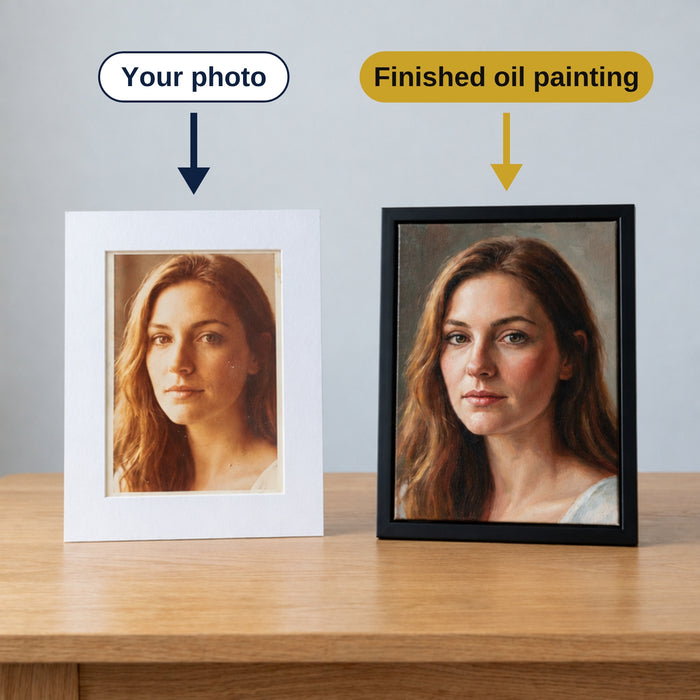
Kahlo's self-portraits are, at heart, portraits of a person with the things and creatures she loved. That idea translates well to a commission. Our Oil Painting Portrait from Photo is painted from your photos in Realism, Impressionist or Pop Art style, with up to four subjects on one canvas, so a person and their dog, cat or parrot can share the frame.
Backgrounds can be changed, so a plain phone snap can sit against deep green leaves, flowers or a coloured wall, and photos taken at different times can be combined. Sizes run from 40 x 50 to 100 x 150 cm.
It starts with a 20% deposit. You receive a photo of the finished painting to approve, changes before approval are free and unlimited, and the balance is charged only once you are happy. Portraits take 21 to 28 days to make. More detail is on our custom portraits page.
Questions people ask
What is Frida Kahlo's most famous painting?
The Two Fridas (1939) is usually named first. It is her largest and best-known canvas, showing two versions of herself joined by one vein, and it hangs in the Museo de Arte Moderno in Mexico City. Self-Portrait with Thorn Necklace and Hummingbird (1940) is a close second.
Which Frida Kahlo self portrait is the most famous?
Self-Portrait with Thorn Necklace and Hummingbird (1940) is the most widely recognised single self-portrait, with its thorn necklace, dead hummingbird, monkey and black cat. Self-Portrait with Cropped Hair (1940) and Self-Portrait with Monkey (1938) follow it.
What was Frida Kahlo and Diego Rivera's relationship?
Kahlo married the muralist Diego Rivera in 1929. They divorced in 1939 and remarried in 1940, and stayed married until her death in 1954. The marriage runs through her work, from Frieda and Diego Rivera (1931) to The Two Fridas.
Do you sell Frida Kahlo prints as well as paintings?
Kahlo's own works are offered as hand-painted oil reproductions only, not prints. If you would like a printed canvas, Homage to Frida is a colourful floral canvas print inspired by her, printed, stretched and framed in Melbourne, with a make time of 10 to 14 days.
Related guides
- Famous Van Gogh Paintings Explained: Starry Night, Sunflowers, Almond Blossom
- Famous Klimt Paintings Explained: The Kiss, Adele Bloch-Bauer and the Golden Phase
- Floating Frames Explained: Gold, Black, Silver, Natural or White
Next step: Browse every hand-painted reproduction in our Frida Kahlo paintings collection and try your favourite on your own wall before you order.