In this guide
Many of the most famous Australian paintings come from the Heidelberg School, a group of young Melbourne artists who, in the late 1880s and 1890s, took their easels outdoors to paint the bush, the light and the working life of the country. Tom Roberts' Shearing the Rams, Frederick McCubbin's Down on His Luck and Arthur Streeton's Golden Summer, Eaglemont are the pictures most Australians recognise, often without knowing who painted them. Here is the story behind each one, where to see it, and how to hang these works at home.
What was the Heidelberg School?
The Heidelberg School, also called Australian Impressionism, was a loose circle of painters led by Tom Roberts, Frederick McCubbin, Arthur Streeton and Charles Conder. Influenced by the open-air painting then popular in Europe, they wanted to paint Australia as it actually looked: bleached grass, blue-grey gums, harsh sun and long shadows, rather than the softened, European-style scenery of earlier colonial art.
The name comes from Heidelberg, then a rural area on the outskirts of Melbourne, where several of the artists painted together.
The artists' camps
Before Heidelberg there were camps at Box Hill and Mentone, where Roberts, McCubbin and friends spent weekends painting outdoors in the mid-1880s. Roberts captured that life in The Artists' Camp (1886), a small, warm scene of painters resting by a campfire at dusk, now in the National Gallery of Victoria. Our Artists' Camp reproduction is landscape-shaped.
In 1888 the group set up at Eaglemont, on a hill near Heidelberg, in an old farmhouse. Streeton, Roberts and Conder painted there through the summers, looking out over the Yarra valley. Some of the best-loved works of the movement were painted in that landscape.
What was the 9 by 5 Impression Exhibition?
In August 1889 Roberts, Streeton, Conder and others held the 9 by 5 Impression Exhibition in Melbourne. Most of the works were painted on wooden cigar-box lids measuring 9 by 5 inches, quick sketches meant to catch a passing effect of light or weather.
The critics were not kind, and a scathing review from James Smith became part of the show's legend. Today the exhibition is seen as the moment Australian Impressionism announced itself, and the surviving panels are prized by major galleries.
Famous Australian paintings by Tom Roberts
Roberts was the group's natural leader, and his large subject pictures are among the best known in Australian art. You can see his range, from beach scenes to portraits, in our Tom Roberts collection.
Shearing the Rams (1890)

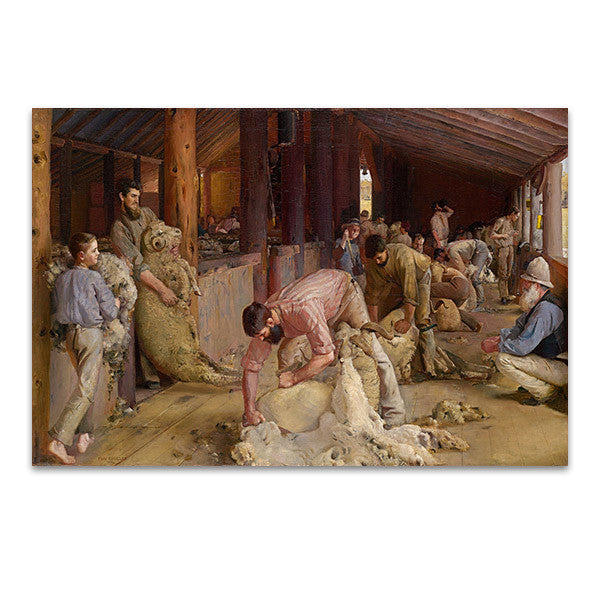
Probably the most famous Australian painting of all, Shearing the Rams shows shearers bent over sheep in a dim woolshed, with sunlight cutting through the timber walls. Roberts made studies for it at Brocklesby station in the Riverina, New South Wales. It celebrates hard, skilled work at a time when wool underpinned the colonial economy, and it hangs in the National Gallery of Victoria. Our Shearing the Rams reproduction is landscape-shaped, from 60x50 cm to 200x135 cm.
The Golden Fleece (1894)

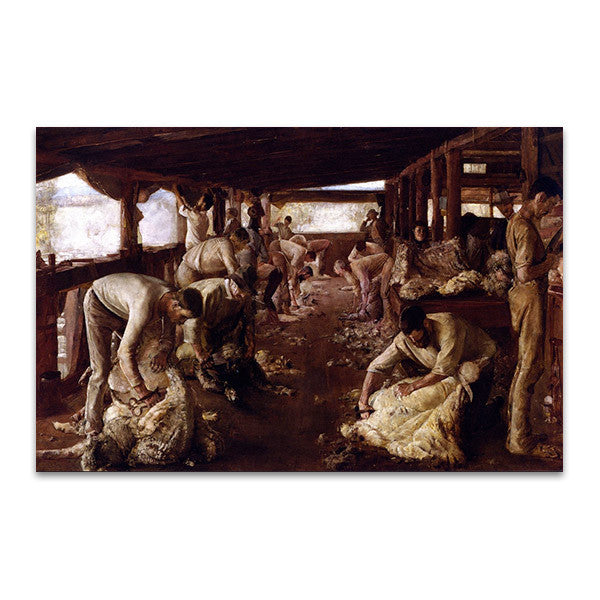
Four years later Roberts returned to the shearing shed with The Golden Fleece, first exhibited as Shearing at Newstead. It is brighter and more open than Shearing the Rams, full of golden light and movement, and belongs to the Art Gallery of New South Wales. Our Golden Fleece reproduction comes in the same landscape sizes, 60x50 cm to 200x135 cm.
Frederick McCubbin: stories of the bush
McCubbin was the storyteller of the group. His paintings are quieter and more reflective, often built around a single figure and a feeling of isolation in the bush. Browse them all in our Frederick McCubbin collection.
Lost (1886)
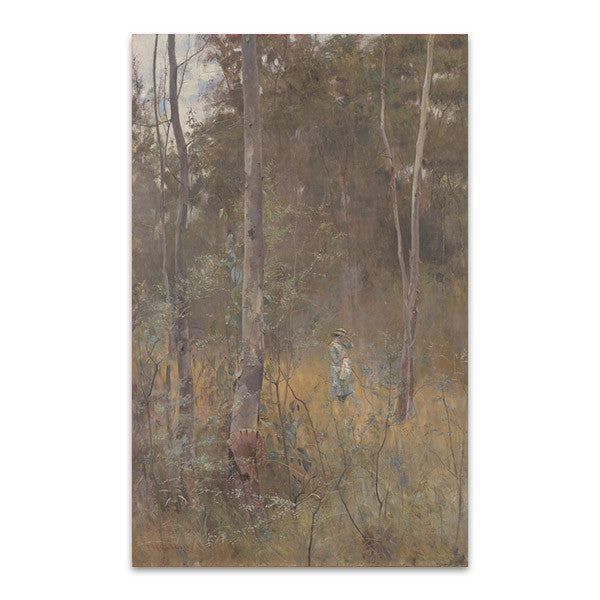
Lost shows a small girl alone among tall, thin gums and long dry grass, almost swallowed by the bush. Stories of children lost in the bush were well known in colonial Victoria, and McCubbin turned that fear into a painting of real tenderness. It belongs to the National Gallery of Victoria. Unlike most of the works here, our reproduction of Lost is portrait-shaped (taller than wide), from 50x60 cm to 135x200 cm.
Down on His Luck (1889)

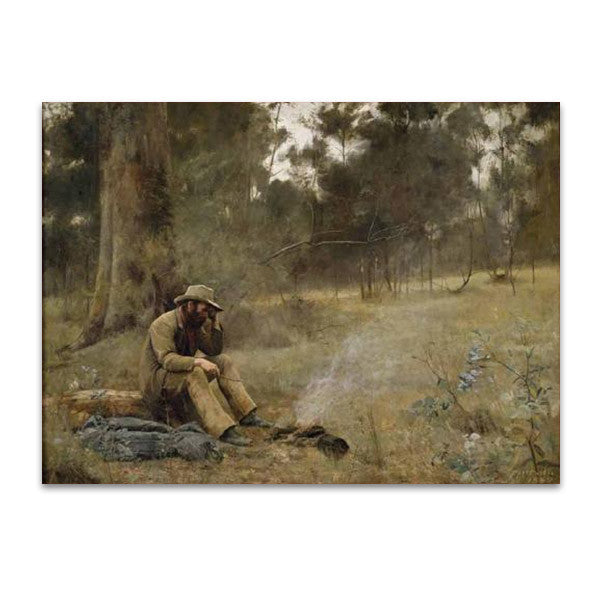
A swagman sits by a small fire, lost in thought, with the bush closing in behind him. Down on His Luck is one of the defining images of the Australian battler, and the original is in the Art Gallery of Western Australia. Our Down on His Luck reproduction is landscape-shaped, from 60x50 cm to 200x135 cm, and suits a study, den or reading nook.
On the Wallaby Track (1896)
In On the Wallaby Track a mother rests with her baby beneath the gums while her husband boils the billy, a family on the move in search of work. It is warm and hopeful despite the hardship, and it hangs in the Art Gallery of New South Wales. Our On the Wallaby Track reproduction is landscape-shaped, from 60x50 cm to 200x135 cm.
Arthur Streeton: the painter of heat and light
Streeton was the member of the group most in love with sunlight. Golden Summer, Eaglemont (1889), a sweeping view of sunburnt paddocks and grazing sheep in the Heidelberg hills, is his best-known work and is held by the National Gallery of Australia in Canberra.

Streeton painted the same country on a smaller scale in Near Heidelberg (1890), painted at Eaglemont: a single tall gum, a golden hillside and a few small figures under a wide blue sky. It is in the National Gallery of Victoria. Our Near Heidelberg reproduction is portrait-shaped, from 50x60 cm to 135x200 cm. You will find more of his harbour and landscape views in our Arthur Streeton collection.
Famous Australian paintings at a glance
| Painting | Artist | Year | Gallery | Our reproduction's shape |
|---|---|---|---|---|
| Shearing the Rams | Tom Roberts | 1890 | National Gallery of Victoria | Landscape |
| The Golden Fleece | Tom Roberts | 1894 | Art Gallery of New South Wales | Landscape |
| The Artists' Camp | Tom Roberts | 1886 | National Gallery of Victoria | Landscape |
| Lost | Frederick McCubbin | 1886 | National Gallery of Victoria | Portrait |
| Down on His Luck | Frederick McCubbin | 1889 | Art Gallery of Western Australia | Landscape |
| On the Wallaby Track | Frederick McCubbin | 1896 | Art Gallery of New South Wales | Landscape |
| Golden Summer, Eaglemont | Arthur Streeton | 1889 | National Gallery of Australia | Not in our range |
| Near Heidelberg | Arthur Streeton | 1890 | National Gallery of Victoria | Portrait |
Landscape sizes are 60x50, 90x60, 100x75, 120x90, 150x100, 180x120 and 200x135 cm. Portrait sizes are 50x60, 60x90, 75x100, 90x120, 100x150, 120x180 and 135x200 cm. All sizes are the canvas, width by height.
Other famous Australian artists
The Heidelberg School is only one chapter. Later artists produced paintings just as widely known, such as Sidney Nolan's Ned Kelly series from the 1940s and Albert Namatjira's watercolours of Central Australia. Our range focuses on the Heidelberg painters and on landscapes of the same spirit, collected in our Australian art collection.
What size Australian painting should I hang?
Choose the nearest size in the artwork's own shape. Heidelberg School paintings are mostly wide landscapes, but some, like Lost and Near Heidelberg, are taller than they are wide, so check the shape before you measure.
- Landscape works above long furniture. Aim for about two-thirds to three-quarters the width of the sofa, sideboard or bed below. Above a sofa about 200 cm wide, 150x100 cm fits that range. Above a queen bed (about 153 cm), try 100x75 cm or 120x90 cm; above a king bed (about 183 cm), 120x90 cm or 150x100 cm.
- Portrait works on narrow walls. A portrait-shaped painting such as Lost suits a hallway, a wall beside a doorway or a space between windows. Measure the wall height as well as the width.
- Hang at eye level. Centre the painting 145 to 150 cm from the floor, and leave 15 to 25 cm between the top of the furniture and the bottom of the frame.
- Pair the stories. Roberts' two shearing scenes are both landscape-shaped, so they pair neatly at the same size, for example two at 90x60 cm. Leave 5 to 8 cm between pieces.
- Allow for the frame. Sizes are the canvas. A floating frame, a slim frame that leaves a small gap around the canvas edge, adds about 2 to 3 cm each side and feels contemporary. An ornate frame such as "Gold Ornate Outer Frame" suits the period and adds about 8 to 12 cm each side.
- Mind the light. Avoid direct sunlight and humid spots, and dust gently with a soft, dry cloth.
Not sure about scale? Our size guide covers room-by-room sizes, and "See it in your room" on every painting page places the painting on a photo of your own wall, to scale.
Questions people ask
What is the most famous Australian painting?
Tom Roberts' Shearing the Rams (1890), at the National Gallery of Victoria, is usually named first, alongside McCubbin's Down on His Luck and Streeton's Golden Summer, Eaglemont.
Why is it called the Heidelberg School?
Several of the artists painted together at Eaglemont, near Heidelberg on the edge of Melbourne, in the late 1880s and early 1890s.
Are your Australian paintings prints?
No. Our paintings are 100% hand-painted in oils on canvas by professional, university-trained artists. Canvas prints are sold separately and clearly labelled as prints.
What sizes do your Australian paintings come in?
It depends on the painting's shape. Landscape works such as Shearing the Rams run from 60x50 cm to 200x135 cm, and portrait works such as Lost from 50x60 cm to 135x200 cm. Each product page lists the exact sizes for that painting, so choose the nearest size in the artwork's own shape.
Related guides
Next step: browse the Australian art collection and use "See it in your room" to find the right size for your wall.